Understanding Amazon Holiday Demand
Amazon holiday demand increases sharply during November and December as shoppers rush to buy gifts, household items, and last-minute deals. Unlike regular months, buying behavior during holidays is emotional, time-sensitive, and highly reactive to availability and pricing.
Amazon holiday demand does not grow steadily. It spikes suddenly, slows briefly, and then spikes again around key moments like Thanksgiving, Christmas week, and year-end sales. Sellers who treat this period like a normal sales cycle often lose both profit and visibility.
When holiday demand rises, pricing needs to react quickly or the opportunity is lost.
Why Holiday Demand Spikes So Fast on Amazon
Holiday demand spikes happen because multiple triggers overlap at the same time.
Shoppers are driven by deadlines, not research
Gift buyers prioritize delivery speed over price
Stockouts push buyers to the next available seller
Amazon increases traffic through promotions and emails
These factors cause amazon holiday demand to surge in short windows, sometimes lasting only a few hours. Pricing that does not adjust during these windows becomes outdated almost immediately.
How Holiday Demand Impacts Pricing Performance
When holiday demand increases, Amazon’s system rewards sellers who stay competitive while maintaining availability. Pricing plays a major role in how listings perform during these spikes.
If prices remain static during high demand periods, sellers experience:
Loss of Buy Box rotation
Missed margin opportunities
Faster inventory depletion
Lower visibility during peak traffic
Responsive pricing helps sellers stay aligned with demand instead of reacting after sales slow down.
Pricing Behavior During Holiday Demand Spikes
| Holiday Scenario | Demand Behavior | Pricing Impact |
|---|---|---|
| Pre-Christmas surge | Rapid increase | Opportunity to raise price |
| Competitor stockout | Sudden spike | Higher Buy Box share |
| Last-minute shopping | Short peak windows | Need fast adjustments |
| Post-holiday slowdown | Sharp drop | Gradual price correction |
This table shows how amazon holiday demand changes quickly and why pricing must adapt in real time.
How Pricing Should Respond to Amazon Holiday Demand
Pricing during holidays should respond to demand, not fear of competition.
When amazon holiday demand increases, sellers should focus on:
Adjusting prices more frequently
Raising prices when inventory drops fast
Avoiding panic discounts during high traffic
Letting demand guide price movement
Demand-based pricing ensures sellers benefit from increased traffic instead of giving away margin unnecessarily.
Amazon Holiday Demand vs Pricing Responsiveness
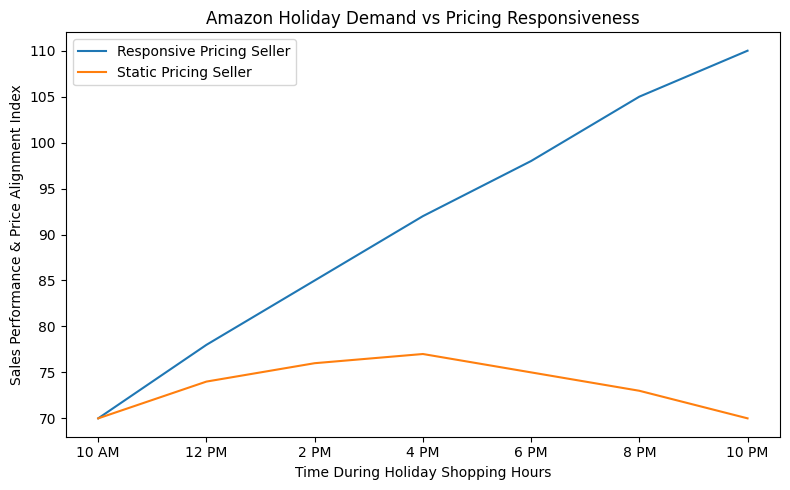
This graph compares two sellers during a holiday demand spike.
X-Axis
Time during holiday shopping hours
Y-Axis
Sales performance and price alignment
What the graph shows:
Seller using responsive pricing stays aligned with demand spikes
Seller using static pricing falls behind during peak hours
Performance gap widens as demand increases
Faster pricing response leads to higher conversion during short demand windows
The visual clearly shows that amazon holiday demand rewards sellers who react quickly and penalizes those who delay price changes.
Common Pricing Mistakes During Holiday Demand
Many sellers misunderstand how amazon holiday demand works and make avoidable mistakes.
Holding prices too low during peak demand
Reacting late to competitor stockouts
Ignoring demand signals until sales slow
Treating holidays like normal sales periods
These mistakes reduce profitability even when traffic is at its highest.
Final Thoughts on Amazon Holiday Demand and Pricing
Amazon holiday demand creates some of the most profitable opportunities of the year, but only for sellers who understand how fast it moves. Demand spikes are short, intense, and unforgiving to slow pricing decisions.
Sellers who align pricing with amazon holiday demand capture higher margins, maintain visibility, and avoid unnecessary discounting. Those who fail to respond quickly often realize the opportunity only after it has passed.
Holiday success on Amazon is not about lowering prices. It is about responding intelligently to demand when it matters most.