Understanding the Slow Week After Christmas on Amazon
The slow week after Christmas is one of the most misunderstood periods on Amazon. Many sellers panic when traffic drops and immediately lower prices, assuming demand has disappeared. In reality, demand has shifted, not vanished.
A smart amazon pricing strategy during this week focuses on stability, margin protection, and preparation for New Year buying behavior. Sellers who react emotionally often lose profit and positioning that takes weeks to recover.
Why Demand Drops After Christmas but Does Not Disappear
After December 25, shopper behavior changes quickly.
Gift buying slows
Returns increase
Browsing replaces impulse buying
Buyers become price-aware again
This does not mean sales stop. It means the marketplace resets. An effective amazon pricing strategy adapts to this shift instead of fighting it.
Common Pricing Mistakes Sellers Make After Christmas
Many sellers damage their performance during the slow week by making avoidable mistakes.
Dropping prices too quickly
Trying to match aggressive competitors
Ignoring Buy Box stability
Discounting products with healthy inventory
These actions reduce margins without increasing volume. A controlled amazon pricing strategy avoids these traps.
Right Pricing Actions During the Slow Week After Christmas
| Situation | Common Reaction | Recommended Pricing Action |
|---|---|---|
| Traffic decline | Panic price drop | Hold price steady |
| Competitor discounting | Match immediately | Wait and observe |
| Inventory still healthy | Clearance pricing | Margin protection |
| Low Buy Box share | Price slashing | Gradual adjustment |
| Preparing for January | No action | Strategic price reset |
This table highlights why patience matters during post-holiday repricing.
How Amazon Pricing Strategy Should Change After Christmas
The goal during the slow week is not aggressive selling. The goal is positioning.
A strong amazon pricing strategy during this period includes:
Smaller price adjustments
Fewer repricing triggers
Focus on Buy Box stability
Avoiding unnecessary discounts
Preparing listings for January demand
Pricing should become deliberate, not reactive.
Post-Christmas Demand vs Pricing Stability
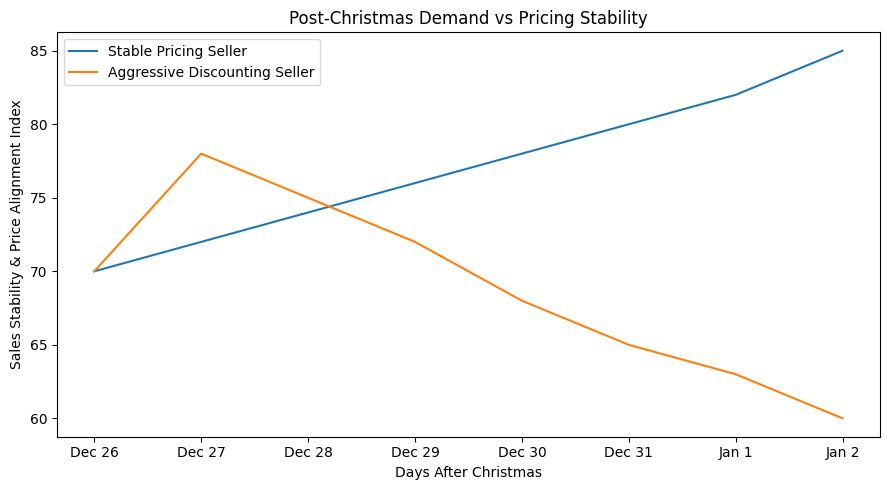
This graph compares two sellers during the slow week after Christmas.
X-Axis
Days after Christmas (Dec 26 to Jan 2)
Y-Axis
Sales stability and price alignment
What the graph shows:
Seller maintaining stable pricing experiences a gradual sales recovery
Seller aggressively lowering prices sees short spikes followed by decline
Price stability leads to better Buy Box consistency
Excessive discounting weakens listing performance before January
The visual clearly shows that a calm amazon pricing strategy performs better than panic pricing after Christmas.
Why Price Stability Matters More Than Volume After Christmas
During the slow week, Amazon’s system evaluates offer consistency. Sellers who constantly change prices signal instability.
A steady amazon pricing strategy helps:
Maintain Buy Box rotation
Preserve conversion history
Avoid algorithm penalties
Protect long-term ranking
This week is about protecting what you earned during Q4, not chasing every order.
How to Decide Whether to Hold or Adjust Prices After Christmas
During the slow week after Christmas, many sellers struggle to decide whether prices should stay the same or change. The answer depends less on emotion and more on signals.
If inventory levels are healthy and Buy Box share remains stable, holding prices is often the best option. Sudden price drops in this situation usually reduce margins without increasing sales volume. A steady amazon pricing strategy allows listings to remain competitive while the market settles.
If inventory is moving too slowly and Buy Box visibility is low, small and controlled adjustments may help. These changes should be gradual, not aggressive. The goal is to test demand response, not to clear inventory at any cost.
By using data instead of panic, sellers can make smarter decisions during this transition period and protect long-term performance heading into the New Year.
Preparing Prices for the New Year Using the Slow Week
The slow week after Christmas is the perfect time to reset.
Review Q4 performance
Identify profitable price points
Remove temporary holiday rules
Prepare for January traffic patterns
Sellers who plan during this week start the New Year stronger.
Final Thoughts on Amazon Pricing Strategy After Christmas
The slow week after Christmas is not a failure period. It is a transition period. Sellers who understand this use pricing to stabilize performance rather than react emotionally.
A thoughtful amazon pricing strategy during this week protects margins, maintains visibility, and positions listings for New Year success. Sellers who rush to discount often undo weeks of hard-earned progress.
The right response after Christmas is not lower prices. It is smarter pricing.