
Why Pricing Rules Matter More Than Individual Price Changes
Many sellers focus on individual price changes instead of the system behind them. This approach creates inconsistency and forces constant manual decisions.
Pricing rules shift the focus from reacting to every change to defining how prices should behave under specific conditions. When rules are designed correctly, pricing decisions become predictable, repeatable, and easier to manage throughout the year.
Strong pricing rules remove emotion from pricing and replace it with structure.
What Makes Rule-Based Pricing Effective Year-Round
Rules that work all year are flexible without being loose. They allow prices to move when necessary but prevent unnecessary changes.
Effective pricing rules are built on:
- Clear minimum and maximum boundaries
- Defined triggers for adjustments
- Controlled reaction speed
- Consistent logic across seasons
Instead of rebuilding pricing logic every few months, sellers can rely on a stable framework that adapts naturally.
Why Seasonal Pricing Without Rules Fails Over Time
Seasonal pricing often depends on manual changes during high-demand periods. This creates gaps during slower months when pricing becomes inconsistent.
Without pricing rules, sellers:
- Over-adjust during peaks
- React too slowly during slow periods
- Lose control of margins
- Create Buy Box instability
Rules provide continuity between seasons and reduce performance swings.
Rule-Based Pricing vs Manual Pricing
| Aspect | Rule-Based Pricing | Manual Pricing |
|---|---|---|
| Consistency | High | Low |
| Margin protection | Strong | Weak |
| Buy Box behavior | Stable | Volatile |
| Reaction quality | Measured | Emotional |
| Year-round reliability | Yes | No |
This table highlights why pricing rules outperform manual adjustments over time.
How to Design Pricing Rules for Different Parts of the Year
A single rule rarely works perfectly in every situation. The key is designing layered logic that responds to different conditions.
For example:
- Stable rules for low-demand periods
- More responsive rules for peak demand
- Inventory-aware rules for stock pressure
- Buy Box-focused rules for competitive ASINs
These layers allow pricing rules to stay relevant throughout the year.
Year-Round Pricing Rules vs Manual Pricing
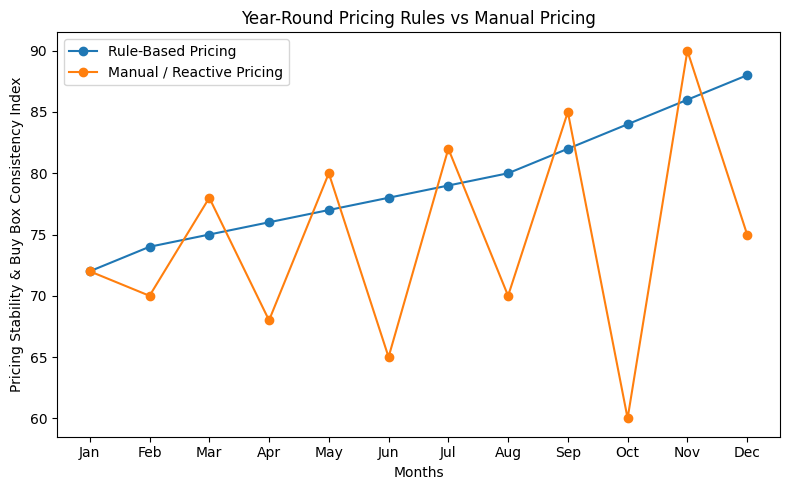
Graph Explanation
This graph compares two sellers across a full year.
X-Axis
Months from January to December
Y-Axis
Pricing stability and Buy Box consistency index
What the graph shows
- The seller using pricing rules maintains a steady upward trend throughout the year
- The seller relying on manual pricing experiences repeated spikes and drops
- Rule-based pricing delivers consistent performance in both low and high demand periods
- Manual pricing creates volatility, especially during seasonal transitions
The visual clearly shows that pricing rules outperform reactive pricing over the long term.
How Pricing Rules Reduce Decision Fatigue
Manual pricing requires constant attention. Every fluctuation becomes a decision point.
Pricing rules reduce this burden by handling routine decisions automatically. Sellers can focus on strategy instead of daily adjustments, improving consistency and reducing errors.
Over time, this leads to better performance and less stress.
How InstaRepricer Helps Apply Pricing Rules at Scale
Creating rules is only half the challenge. Applying them consistently across many ASINs is where most sellers struggle.
InstaRepricer allows sellers to define pricing rules once and apply them automatically across listings. Rules execute consistently, respond to real market signals, and prevent unnecessary price changes.
This makes it easier to maintain controlled pricing behavior all year without manual oversight.
Why Consistency Matters More Than Frequent Adjustments
Pricing performance improves when behavior is predictable. Constant changes, even small ones, create uncertainty for both buyers and Amazon’s systems. Listings that behave consistently tend to recover faster during slow periods and perform more reliably during high demand.
When prices remain steady unless conditions truly change, conversion patterns become clearer and Buy Box rotation stabilizes. This makes it easier to identify what is working and what needs attention.
Consistency is not about ignoring the market. It is about responding only when signals are meaningful, which leads to better long-term results.
Final Thoughts
Pricing success does not come from reacting faster than competitors. It comes from having a system that works in every season.
Well-designed pricing rules provide structure, protect margins, stabilize Buy Box behavior, and reduce pricing mistakes. Sellers who invest in rules instead of reactions create pricing systems that perform reliably all year long.