
Introduction: A Complete Guide for Sellers Using Smart Holiday Amazon Repricing Strategy
The holiday season is the most profitable period of the year but also the most unpredictable. While sellers optimize listings, stock up on inventory, and brace for surging demand, an invisible threat quietly eats away at profits:
Unexpected Q4 operational costs.
Every year, sellers lose 10–22% of their holiday profits because they fail to adjust their repricing floor, margin buffers, and rule-design to reflect seasonal cost spikes.
This guide reveals how to safeguard your margins using a smart Holiday Amazon Repricing Strategy designed to counter Q4 volatility.
Why Unexpected Costs Surge in Q4
From mid-November to December, Amazon enforces multiple seasonal adjustments that’s why you need a holiday amazon repricing strategy:
| Cost Category | Typical Increase During Holidays | Why it Happens |
|---|---|---|
| Shipping Surcharges | +20–30% | Peak season carrier demand & load |
| Returns Handling | +10–18% | Gift returns + incorrect sizes + damaged shipments |
| FBA Fees | +8–12% | Seasonal operational adjustments |
| Storage Fees | +18–25% | Higher demand for storage space |
These rising costs directly impact your margins unless your repricing strategy (holiday amazon repricing strategy) compensates for them.
Unexpected Holiday Cost Increases (%)
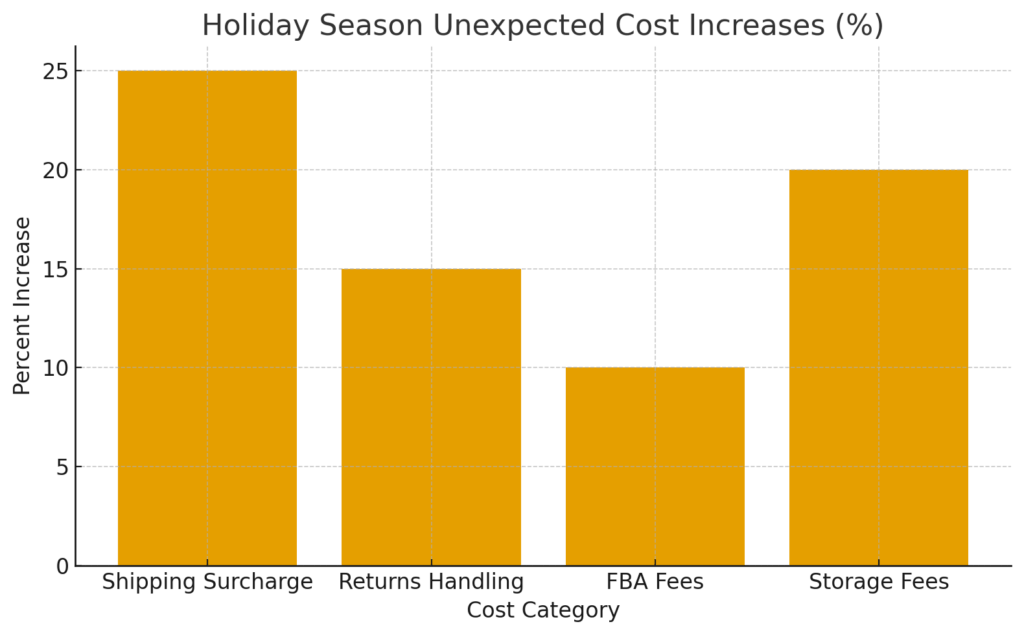
The graph highlights how core expense categories shipping surcharges, return-processing costs, FBA fee increases, and storage fees spike during Q4, demonstrating why every seller needs a well-planned holiday Amazon repricing strategy. These unpredictable costs can quickly erode margins, especially when sales velocity rises but operational expenses rise even faster.
How Unexpected Costs Destroy Profit Margins
When fees increase but your minimum price and margin rules stay the same:
- Your floor price becomes outdated, causing hidden losses
- Your competitor-matching rules may push prices too low
- Your Buy Box strategy may sacrifice margin unnecessarily
- Your profit per unit silently erodes even if sales increase
This is why every serious seller needs a Holiday Amazon Repricing Strategy built around cost buffers.
Holiday Safety Net #1: Increase Your Margin Buffer
Most sellers use a fixed buffer year-round but Q4 requires a flexible one.
Recommended Q4 Buffer Adjustments
| Cost Type | Suggested Additional Buffer |
|---|---|
| Shipping | +5–8% |
| Returns | +3–5% |
| Amazon Fees | +2–4% |
| Storage | +4–6% |
Example:
If your usual margin floor is 18%, shift it to 28–30% for the holiday period.
This ensures your repricer never dips below a threshold that risks profit loss.
Holiday Safety Net #2: Repricing Floors Based on Seasonal Fee Forecasting
Set floor prices using:
- Expected seasonal fee increase
- Category-specific sensitivity
- Inventory velocity
- Return probability of the product
High-risk categories (electronics, toys, clothing) should have the highest floor-price protection.
Holiday Safety Net #3: Use Shipping-Delay Aware Repricing Rules
When shipping delays spike:
- More customers cancel orders
- Negative feedback increases
- You may lose Buy Box momentum
Smart repricers like InstaRepricer allow rule modifications such as:
Raise prices when shipping cost spikes
Auto-increase price during carrier delays
Protect Buy Box only if margin meets your minimum threshold
Holiday Safety Net #4: Adjust Repricing During Peak-Return Window (Dec 26 – Jan 15)
This period is often overlooked.
Returns explode during these two weeks.
What to do:
- Add a post-holiday return buffer of +3–7%
- Slow down repricing to avoid selling too fast during low-profit return-heavy days
- Increase prices slightly to offset expected restocking losses
This is one of the smartest margin-recovery techniques you can implement.
Holiday Safety Net #5: Manage Overstock with Gradual Price Recovery
If you overstock during Q4, NEVER do a sudden discount.
Instead:
- Begin reducing prices in small 3–5% increments
- Monitor competitor reactions
- Use a velocity-based rule
- Protect minimum margin buffer
Gradual price recovery protects margins while still clearing stock.
Conclusion: Your Holiday Amazon Repricing Strategy Is the Difference Between Profit & Loss
The holiday season is profitable but only for sellers who plan for hidden costs.
Protect yourself with:
Margin buffers
Updated repricing floors
Seasonal fee forecasting
Safe Q4 repricing rule-design
Post-holiday return strategy
A smart repricer like InstaRepricer can automate all of these protections ensuring you win the Buy Box without sacrificing your margins in the most volatile season of the year.