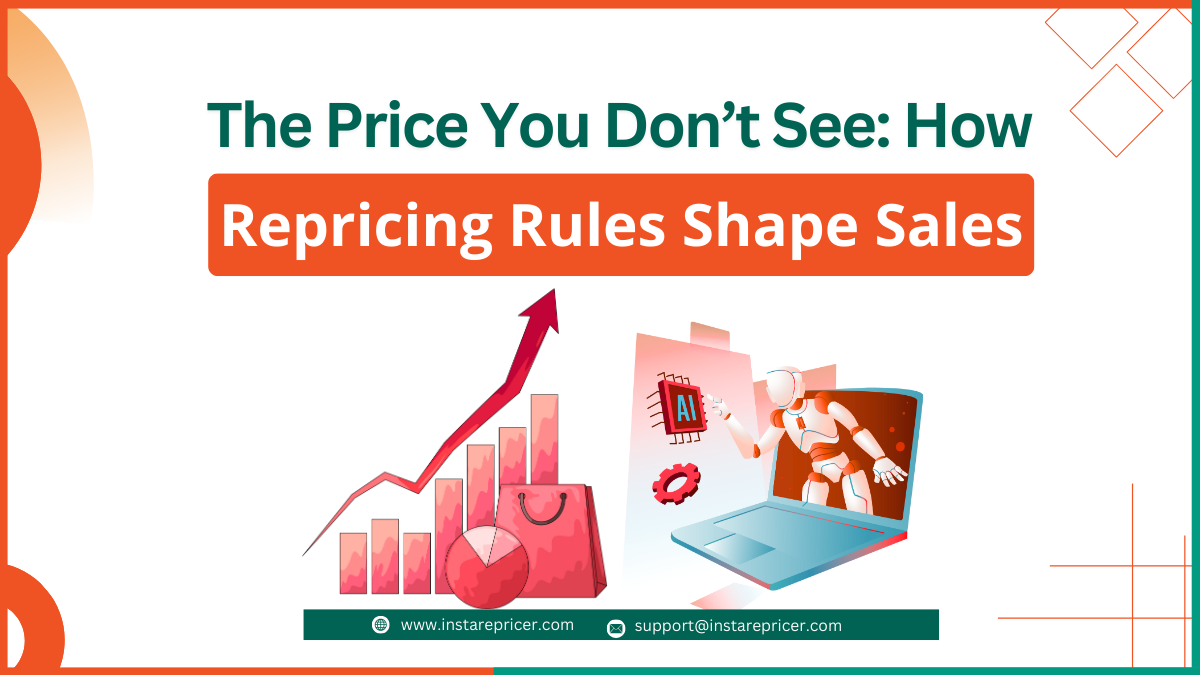
How Invisible Competitor Repricing Rules Shape Your Sales
Most Amazon sellers believe they’re competing against prices numbers on a screen, updated throughout the day.
But the real competition is the rules behind those prices.
The marketplace is full of automated repricers operating with sophisticated logic you never see. These invisible competitor repricing rules decide when a competitor raises price, when they undercut you, when they freeze, when they become aggressive, and when they step back.
You’re not just competing with sellers you’re competing with their algorithms.
And the moment you understand that, your entire pricing strategy changes.
The Layer of Invisible Competitor Repricing Rules
Your competitor’s price isn’t random.
It reflects:
- Their minimum acceptable margin
- Their inventory levels
- Their Buy Box targeting logic
- Their stock age
- Their fulfillment speed
- Their restock timelines
- Their fear of price wars
Each seller has rules you never see.
Those rules silently shape your Buy Box chances, your conversion rate, and even your sales velocity.
This is why some sellers always seem to “magically” regain the Buy Box seconds after you win it.
It’s not magic.
It’s invisible competitor repricing rules firing in the background.
The Emotional Side: Why Invisible Competitor Repricing Rules Catch Sellers Off Guard
You drop your price by $0.10 expecting a Buy Box win.
But your competitor instantly drops theirs by $0.12.
It feels personal but it’s not.
You triggered their rule.
Many sellers get frustrated because they believe competitors are watching them manually.
But the truth is:
You’re fighting logic, not emotions.
Their repricer reacts faster than you can think.
Understanding this calms the emotional panic that causes bad pricing decisions.
What Competitor Rules You Can’t See (But Should Assume)
Here are the main invisible rule types affecting your sales:
1. Undercutting Rules
Competitor always goes $0.01 below your price.
2. Match-Only Rules
Competitor matches your price but never goes lower.
3. Inventory-Based Rules
Competitor raises price when they’re low on stock.
4. Velocity Rules
When their ASIN sells too fast, they increase price.
5. Time-of-Day Rules
Some repricers get aggressive only at night.
6. Buy Box Targeting Rules
They change their strategy as soon as the Buy Box moves.
7. Floor-Price Lock Rules
Competitor never drops below a protected minimum margin.
These rules shape the competition far more than the visible price you see.
When Invisible Competitor Repricing Rules Work Against You
Your sales may slow down without any visible price change.
Why?
Because your competitor’s hidden rules caused:
- A Buy Box rotation shift
- A margin-protection rule to activate
- A price freeze you didn’t anticipate
- A velocity-based price increase
- A stock-out buffer trigger
You’re reacting to the surface while competitors are reacting to the algorithm.
This mismatch creates an uneven battleground.
Visible Price vs Invisible Rules (What You See vs What You Fight)
| What You See | What’s Actually Happening Behind the Scenes |
|---|---|
| A $19.99 competitor price | Competitor is at minimum margin and cannot go lower |
| Competitor suddenly raises price | Their inventory dropped or they’re nearing restock limits |
| Competitor never undercuts you | They’re running a match-only Buy Box strategy |
| Competitor drops price at 2 AM | Their time-triggered rule activates at night |
| Competitor raises price just after you sell out | They use a stock-out monitoring rule |
This is why invisible competitor repricing rules are more important than visible prices.
How Hidden Competitor Rules Manipulate Your Sales Flow
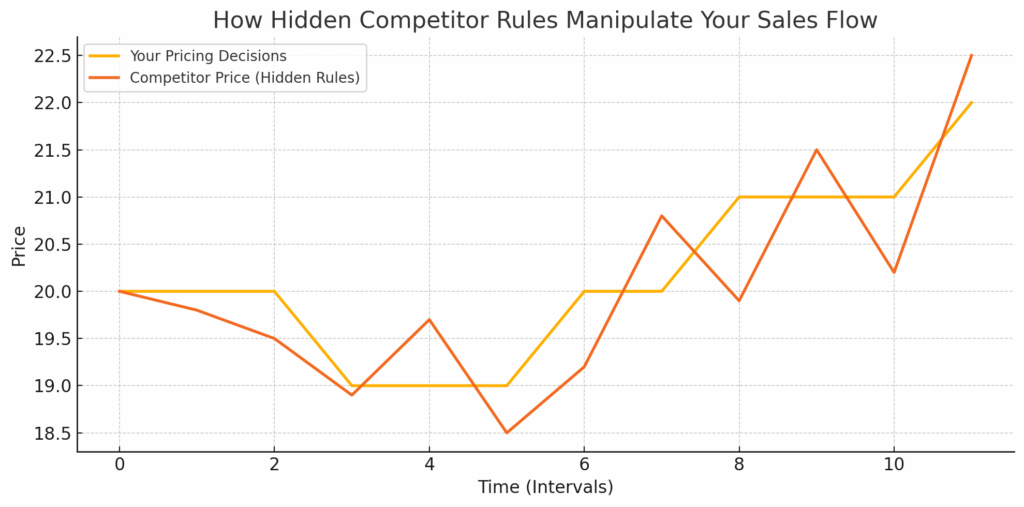
The graph shows two lines: your pricing decisions vs competitor pricing triggered by hidden rules.
While your line moves in predictable, visible steps, the competitor line reacts instantly and unexpectedly reflecting the influence of invisible competitor repricing rules.
Sudden drops, delayed increases, and rapid Buy Box recoveries illustrate how automated systems react to your actions.
This dynamic creates three major effects:
1. Your Buy Box time shrinks unexpectedly
Their algorithm pulls the Buy Box back within seconds.
2. Inventory movement slows
Each time their rule activates, your sales throttles.
3. Profitability becomes unstable
You lower price to compete, while their floor price protects their margins.
The graph visually reinforces a crucial truth:
You’re competing against strategies you cannot see but must anticipate.
How to Counter Competitors’ Invisible Repricing Rules
1. Use a repricer that detects pattern behavior
Look for repetition: drops, matches, or freezes.
2. Protect your floor price aggressively
Their rules are built to push you below profitability.
3. Use time-based strategies
If competitors move at night, automate your night logic.
4. Shift from reactive pricing to predictive pricing
Anticipate their next move.
5. Monitor competitor stock levels
When they run low, their rules change use that window to raise prices safely.
6. Track Buy Box rotation patterns
If rotation is inconsistent, competitor rules are in play.
Final Takeaway
You don’t lose to competitor prices.
You lose to competitor rules.
The numbers you see are only the final output of complex logic running behind the scenes.
Once you learn to anticipate invisible competitor repricing rules, pricing stops feeling random and starts feeling strategic again.
Your power as a seller grows not by lowering prices, but by understanding the rules that control the battlefield.