Why Many Sellers Misunderstand Pricing Automation System
Pricing automation is often misunderstood as a way to react faster than competitors. Many sellers believe automation exists only to change prices quickly.
This mindset creates problems. When automation is treated as a shortcut, sellers expect instant results without structure. Prices move rapidly, but performance becomes unstable.
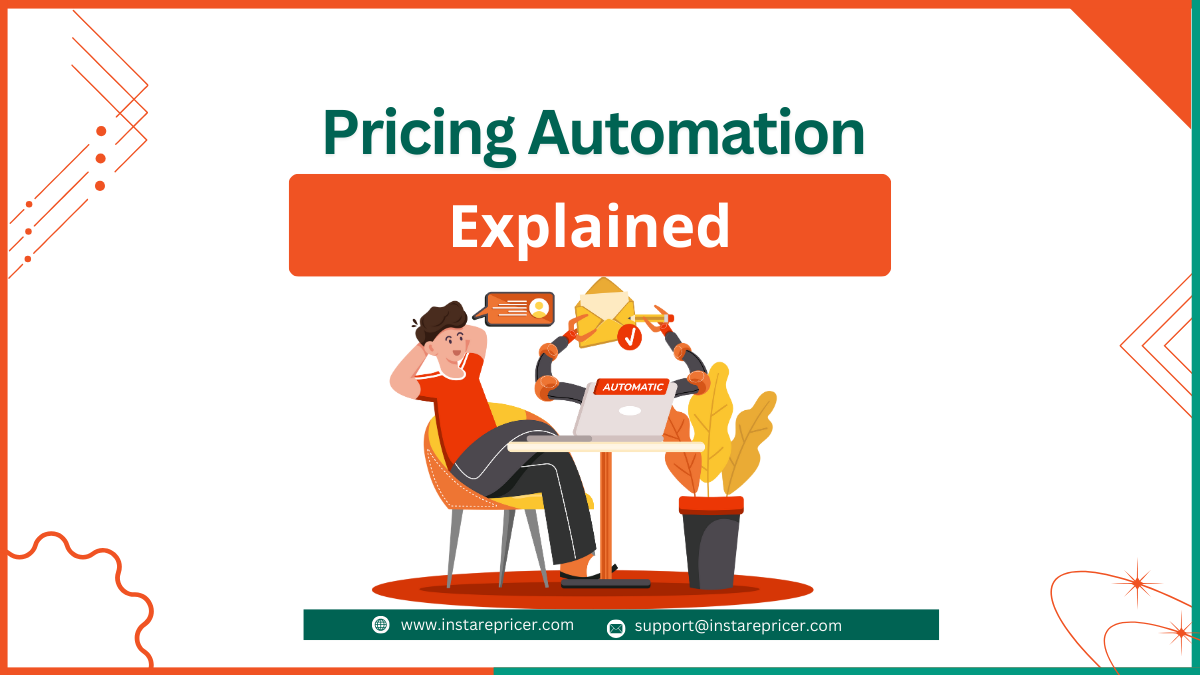
A pricing automation system is not about speed alone. It is about defining how pricing should behave under specific conditions and allowing that logic to operate consistently.
Shortcut Automation vs System-Based Automation
Shortcut automation focuses on reacting to every market movement. System-based automation focuses on controlled responses.
When sellers rely on shortcuts:
- Prices change too frequently
- Margins fluctuate unexpectedly
- Buy Box performance becomes inconsistent
- Manual intervention increases
A pricing automation system replaces reaction with intention.
What Makes Pricing Automation a System
A true pricing automation system includes several components working together:
- Defined minimum and maximum boundaries
- Clear reaction triggers
- Inventory-aware logic
- Controlled adjustment frequency
- Consistent rule structure
Without these elements, automation becomes random rather than reliable.
Systems create predictable behavior. Shortcuts create volatility.
Why Systems Deliver Better Long-Term Results
Shortcuts may show temporary gains, but they rarely sustain performance.
A pricing automation system produces long-term benefits:
- Stable Buy Box rotation
- Predictable margins
- Fewer unnecessary price changes
- Stronger algorithm trust
Instead of chasing competitors, sellers allow the system to guide decisions based on predefined rules.
System-Based Automation vs Shortcut Automation
| Area | System-Based Automation | Shortcut Automation |
|---|---|---|
| Price movement | Controlled | Erratic |
| Margin protection | Strong | Weak |
| Buy Box behavior | Stable | Volatile |
| Rule clarity | High | Low |
| Scalability | Excellent | Poor |
This comparison shows why treating automation as a system leads to better outcomes.
Pricing Automation System vs Shortcut Automation
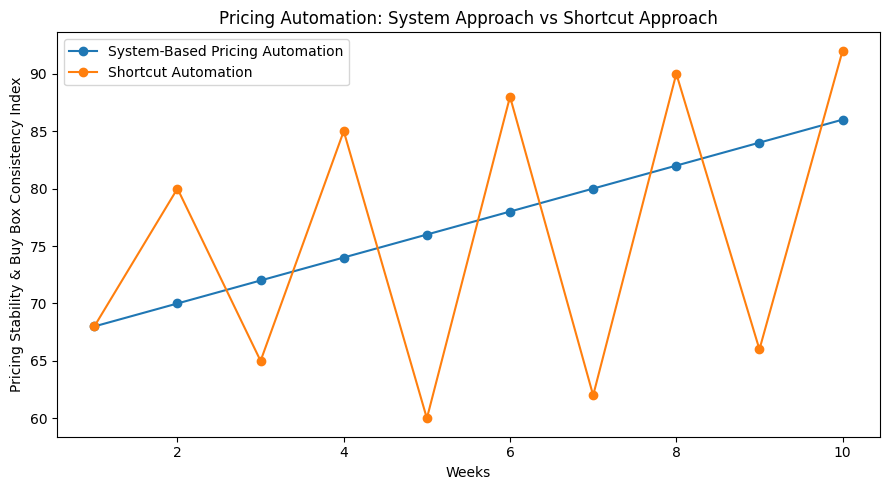
Graph Explanation
This graph compares two Amazon sellers over a ten-week period.
X-Axis
Weeks
Y-Axis
Pricing stability and Buy Box consistency index
What the graph shows
- The seller using a pricing automation system improves steadily each week
- The seller relying on shortcuts experiences sharp spikes and deep drops
- Shortcut automation causes volatility even when demand is stable
- System-based automation produces consistent upward performance
The visual clearly shows that automation succeeds through structure, not speed.
Why Shortcut Automation Fails During Volatile Periods
During peak seasons or competitive surges, shortcut automation becomes dangerous.
Rapid reactions amplify volatility. Prices drop unnecessarily, recover slowly, and confuse Buy Box signals.
A pricing automation system prevents these swings by enforcing boundaries and reacting only when conditions truly change.
Why Predictability Beats Constant Optimization
Many sellers believe pricing must be adjusted constantly to stay competitive. In reality, predictable behavior often outperforms frequent experimentation.
When prices move in a consistent and logical way, both buyers and Amazon’s systems respond more positively. Conversion patterns become easier to analyze, Buy Box rotation stabilizes, and performance trends become clearer.
Predictability does not mean ignoring the market. It means allowing structured logic to guide decisions instead of reacting emotionally to every competitor change.
How a Pricing Automation System Scales With Your Business
As catalogs grow, manual oversight becomes impossible. Shortcut logic breaks quickly under scale.
A pricing automation system allows sellers to:
- Apply consistent behavior across hundreds of ASINs
- Replicate successful logic easily
- Reduce operational stress
- Maintain performance without constant monitoring
Systems scale. Shortcuts do not.
How InstaRepricer Supports System-Based Pricing Automation
InstaRepricer is designed to support pricing automation as a system rather than a reaction engine.
By allowing sellers to define structured rules, boundaries, and conditions, InstaRepricer ensures pricing behavior remains consistent even during market volatility.
This approach removes guesswork and replaces it with repeatable logic.
Final Thoughts on Pricing Automation as a System
Pricing automation is not a magic button. It is a framework.
When sellers treat automation as a shortcut, results become unpredictable. When automation is built as a system, performance becomes reliable.
A well-designed pricing automation system delivers stability, protects margins, and supports long-term growth regardless of market conditions.
Automation works best when structure leads and speed follows.