Introduction: Pricing Rule Audit Guide
Pricing rules are not “set and forget.” Market behavior, competition, and demand patterns change every quarter. Rules that worked well in one season may quietly cause problems in the next.
A regular pricing rule audit helps sellers identify outdated logic before it impacts margins or Buy Box stability. Reviewing rules on a fixed schedule ensures pricing behavior stays intentional and controlled.
What Happens When Pricing Rules Are Not Reviewed
When sellers skip audits, pricing rules drift out of alignment.
Common outcomes include:
- Prices reacting too slowly or too aggressively
- Margins shrinking without explanation
- Buy Box stability declining over time
- Sellers losing confidence in their pricing system
A pricing rule audit prevents these issues before they become visible problems.
When to Schedule a Pricing Rule Audit
The most effective approach is to review rules once every quarter.
Quarterly reviews align well with seasonal shifts:
- Q1 focuses on post-holiday normalization
- Q2 adjusts for steady demand periods
- Q3 prepares for rising competition
- Q4 tightens controls for peak demand
This cadence keeps pricing logic relevant without creating unnecessary work.
What to Review During a Pricing Rule Audit
| Audit Area | What to Check | Why It Matters |
|---|---|---|
| Price floors | Minimum limits | Protects margins |
| Price ceilings | Maximum limits | Avoids overpricing |
| Reaction speed | Update frequency | Prevents volatility |
| Competitor triggers | Price match logic | Reduces noise |
| Inventory signals | Stock-based rules | Prevents stockouts |
This table provides a simple checklist for every pricing rule audit.
How to Run a Pricing Rule Audit Step by Step
Start by reviewing performance data from the previous quarter. Identify where prices moved too often or not enough.
Next, validate whether current rules still match business goals. Check if boundaries are realistic and whether triggers fire too frequently.
Finally, test small adjustments rather than rewriting rules completely. Incremental changes preserve stability while improving performance.
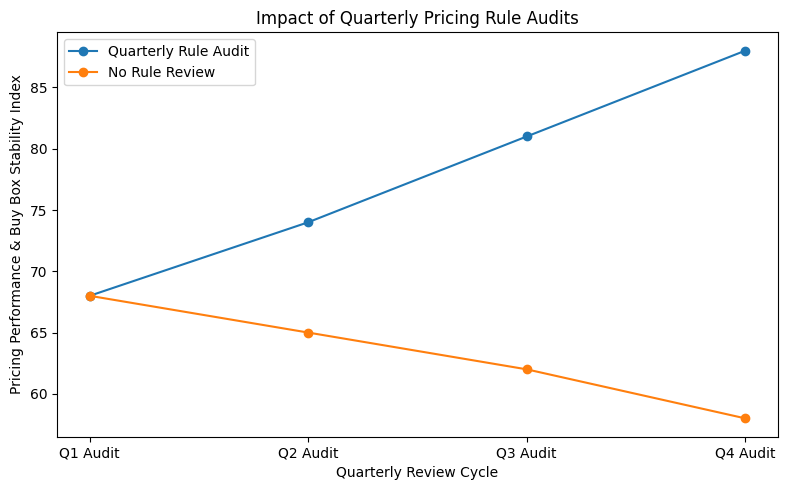
Impact of Quarterly Pricing Rule Audits
Graph Explanation
This graph compares two sellers across four quarters.
X-Axis
Quarterly review cycle (Q1 to Q4)
Y-Axis
Pricing performance and Buy Box stability index
What the graph shows
- The seller performing a quarterly pricing rule audit improves steadily each quarter
- The seller without rule reviews experiences gradual performance decline
- Regular audits strengthen pricing accuracy and Buy Box consistency
- Ignoring rule reviews allows small issues to compound over time
The visual clearly shows that quarterly reviews keep pricing systems healthy and effective.
How Regular Audits Improve Long-Term Pricing Confidence
A pricing rule audit builds trust in the system. Sellers know rules are working because they are reviewed, adjusted, and validated regularly.
This confidence reduces manual overrides and prevents emotional pricing decisions. Over time, audits transform pricing from a reactive task into a reliable process.
Why Small Adjustments Work Better Than Major Rule Changes
Large rule changes often create unintended side effects. When multiple conditions are updated at once, it becomes difficult to identify what actually improved or harmed performance.
Making small, deliberate adjustments allows sellers to measure impact clearly. Minor changes to boundaries, triggers, or reaction timing reduce risk while preserving overall stability.
This approach keeps pricing behavior predictable and prevents sudden disruptions that can affect Buy Box rotation or margins.
How InstaRepricer Simplifies Pricing Rule Audits
InstaRepricer makes pricing rule audits easier by clearly showing which rules are active and how they behave.
Sellers can review logic, adjust boundaries, and apply changes consistently across listings. This removes guesswork and shortens audit time while keeping pricing behavior controlled.
Final Thoughts on Pricing Rule Audits
Quarterly reviews are not about changing everything. They are about ensuring pricing logic still makes sense.
A consistent pricing rule audit protects margins, stabilizes Buy Box performance, and keeps pricing systems aligned with real market conditions. Sellers who audit regularly avoid surprises and maintain steady performance all year.