

Why Pricing Rules Complexity Is a Growing Problem
As Amazon sellers grow, pricing logic often becomes layered and complicated. What starts as a few helpful rules slowly expands into dozens of conditions created over months or years.
This is where pricing rules complexity begins to hurt performance. Each additional rule increases the chance of conflicts, unexpected price movements, and inconsistent behavior.
Instead of gaining precision, sellers lose clarity.
How Pricing Rules Complexity Develops Over Time
Pricing rules are rarely designed all at once. They evolve reactively.
A seller adds a rule to win the Buy Box.
Another rule protects margins.
Another handles inventory pressure.
Over time, pricing rules complexity increases as old logic remains active while new logic is stacked on top. Sellers often forget why some rules even exist.
This accumulation creates unpredictable outcomes.
Why More Rules Do Not Mean Better Control
Many sellers believe that more rules equal more control. In reality, pricing rules complexity reduces control.
When multiple conditions trigger simultaneously, prices may change repeatedly within short periods. This volatility weakens Buy Box stability and confuses performance signals.
Control does not come from quantity. It comes from clarity.
Common Symptoms of Pricing Rules Complexity
Sellers experiencing excessive pricing rules complexity often notice:
- Prices moving without clear explanation
- Margins shrinking unexpectedly
- Difficulty identifying which rule caused a change
- Conflicting reactions to the same competitor behavior
- Increased reliance on manual overrides
These symptoms indicate that the system is no longer working as intended.
Clean Pricing Logic vs Overloaded Logic
| Area | Clean Rule Structure | High Rule Complexity |
|---|---|---|
| Rule clarity | Easy to understand | Confusing |
| Conflict risk | Low | High |
| Price stability | Strong | Weak |
| Margin predictability | Reliable | Inconsistent |
| Buy Box behavior | Stable | Volatile |
This comparison highlights how pricing rules complexity impacts long-term results.
How Pricing Rules Complexity Affects Amazon Algorithms
Amazon rewards predictable behavior. Listings that change prices erratically send mixed signals to the marketplace.
When pricing rules complexity causes frequent fluctuations, Buy Box rotation becomes inconsistent. Conversion signals weaken, and listings struggle to maintain stable visibility.
Simpler pricing logic allows Amazon systems to evaluate offers more reliably.
Why Pricing Rules Complexity Hurts Seller Confidence
When sellers no longer trust their pricing system, they intervene manually. This further increases inconsistency.
Pricing rules complexity often creates a cycle:
confusion leads to overrides, overrides create more rules, and more rules deepen the problem.
A system that cannot be trusted cannot scale.
Pricing Rules Complexity vs Simplified Logic
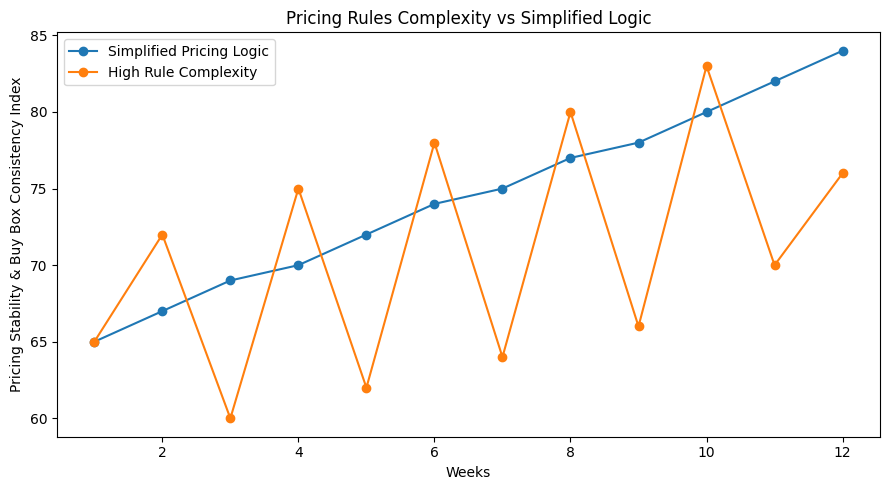
Graph Explanation
This graph compares two sellers over a twelve-week period.
X-Axis
Weeks
Y-Axis
Pricing stability and Buy Box consistency index
What the graph shows
- Seller with simplified logic maintains steady upward performance
- Seller affected by pricing rules complexity experiences repeated spikes and drops
- Excessive rule interaction causes volatility
- Fewer well-designed rules improve long-term stability
The visual clearly demonstrates that complexity reduces predictability.
When Adding New Rules Is Actually Appropriate
Not every new rule is a mistake. Adding logic makes sense when:
- A pricing pattern repeats consistently
- Inventory behavior changes permanently
- Competitive structure shifts long-term
However, each new rule should replace outdated logic rather than stack on top of it. Otherwise pricing rules complexity continues to grow unchecked.
How Rule Conflicts Create Invisible Pricing Problems
Pricing issues are not always obvious. In many cases, prices appear reasonable on the surface but behave unpredictably underneath.
When multiple conditions overlap, one adjustment may cancel out another or trigger repeated changes within a short time window. These conflicts often go unnoticed until margins shrink or Buy Box stability declines.
Without clear visibility into how pricing logic interacts, sellers may misdiagnose the problem and apply even more rules, worsening the situation.
Why Simpler Systems Scale Better Over Time
As catalogs grow, pricing logic must remain easy to manage. Systems that depend on dozens of conditions become difficult to audit, test, or replicate across new listings.
Simpler structures allow sellers to expand confidently without increasing operational risk. When logic is easy to understand, performance issues are easier to trace and corrections are faster to apply.
Scalable pricing systems rely on clarity, not complexity.
How InstaRepricer Helps Reduce Pricing Rules Complexity
InstaRepricer helps sellers simplify pricing behavior by making logic visible and structured.
Instead of stacking rules blindly, sellers can audit existing logic, remove outdated conditions, and apply consistent frameworks across ASINs. This reduces conflicts and restores clarity.
Cleaner systems lead to stronger performance with fewer adjustments.
Final Thoughts on Pricing Rules Complexity
Pricing success does not come from building more rules. It comes from building the right ones.
Reducing pricing rules complexity improves stability, strengthens Buy Box behavior, and protects margins. Sellers who simplify their pricing logic gain control, confidence, and long-term consistency.
When pricing rules work together instead of against each other, performance follows.