The Domino Effect of Repricing Mistakes:
Some Amazon sellers imagine repricing as just numbers a simple calculation of cost, margin and competition. But in reality, repricing is emotional. One wrong price feels like a small slip, a minor adjustment, harmless in the moment.
Yet that single mistake can break your entire sales funnel, starting a chain reaction that impacts visibility, sales velocity, profit, and even brand perception.
This is the domino effect of repricing mistakes.
It doesn’t start with disaster it starts with just one wrong move.
The First Domino: A Price That Doesn’t Fit the Moment
A wrong price is rarely obvious. It can be:
- Too high
- Too low
- Too delayed
- Too aggressive
- Too defensive
It may be caused by:
- A competitor’s sudden price drop
- A vacation mode repricer
- A manual adjustment
- A missed rule update
- Or simple panic when sales slow down
But here’s the emotional truth:
The first domino is not the price it’s the decision.
Fear, impatience, overconfidence, or distraction lead to mispricing (Repricing Mistake).
When that price hits the listing, the analytical dominoes begin.
How One Wrong Price Breaks Everything (Step-by-Step)
Below is the sequence most sellers never notice until it’s too late:
1. Buy Box Loss
Your price no longer matches buyer expectations or competitive pressure.
2. Traffic Drops
Your listing is buried behind others.
3. Conversion Slows
Instead of selling hourly, you start selling daily… or not at all.
4. Inventory Stops Moving
Units sit. The clock starts ticking.
5. Storage Fees Rise
Especially painful in Q4.
6. You React Emotionally
You adjust price again.
And again.
Often the wrong way.
7. Race to the Bottom
You drop price to force movement, losing margins.
Finally…
8. You Sell at a Loss
All because of one decision.
That’s the domino effect of repricing mistakes.
The Emotional Side: Why Sellers Make Repricing Mistakes
Humans are predictable. Under pressure, we:
- Fear losing sales
- Fear losing the Buy Box
- Fear being “too expensive”
- Fear running out of time in Q4
So we drop price preemptively.
We react instead of analyzing.
What’s ironic?
Sometimes you didn’t need to change price at all.
Your competitor might have:
- Lower stock
- Worse feedback
- Higher shipping
- Poor delivery metrics
But emotion beats strategy.
And the wrong price goes live.
The Analytical View: Funnel Breakdown
| Funnel Stage | Impact of Repricing Mistake |
|---|---|
| Visibility | Drops instantly when Buy Box is lost |
| Traffic | Declines due to suppressed listing rotation |
| Conversion | Falls, even if price appears “low” |
| Inventory | Stops selling, creating aging stock |
| Profit | Eaten by fees, storage, panic discounting |
| Brand | Perceived as unstable or cheap |
A pricing error is not just a number.
It is a trigger that affects every funnel stage.
One Mistake → Multiple Losses
Sellers often notice only the surface loss:
“My price was wrong.”
But beneath that are hidden losses:
- Margin loss
- Storage fees
- Rank drop
- Fewer reviews
- Inventory risk
- Algorithm trust
Amazon rewards momentum.
A pricing mistake breaks momentum, and rebuilding it takes far longer than the time it took to lose.
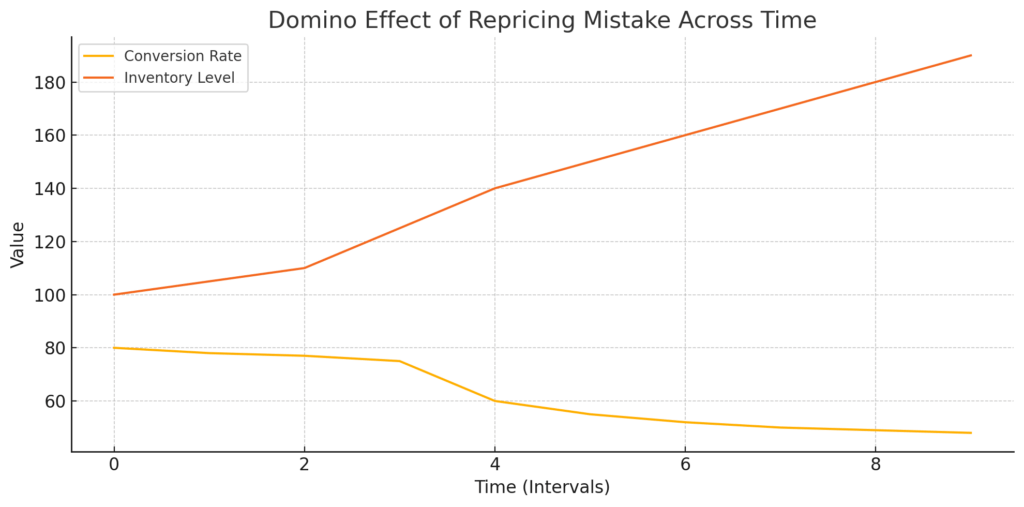
How Repricing Mistakes Trigger a Domino Effect
The graph clearly visualizes the cascading impact of repricing mistakes over time. In the first few intervals, everything appears stable. Conversion rates are healthy, and inventory levels are consistent. Then a single wrong price decision occurs and the entire system reacts.
Immediately after the pricing error, conversion rate begins to drop sharply. The graph shows how one miscalculated adjustment causes visibility loss, Buy Box instability, and a downward trend in sales momentum. As conversions fall, inventory starts to increase, revealing the hidden cost of repricing mistakes: unsold products pile up while storage fees continue to grow.
This visual makes the domino effect impossible to ignore. A single pricing error doesn’t remain isolated. It impacts conversion, inventory movement, profit margins, and even brand trust. The rising inventory curve demonstrates how repricing mistakes create slow-moving stock, while the falling conversion curve shows the emotional and financial consequence of losing the Buy Box.
The takeaway from the graph is simple and powerful:
every repricing mistake sends shockwaves through the sales funnel.
Protecting your funnel from these mistakes requires automation, guardrails, and real-time logic, ensuring that one wrong price never collapses the entire system again.
How to Prevent the Domino Effect of Repricing Mistakes
1. Use Guard Rails (Floor & Ceiling Prices)
Never allow a repricer to drop below cost.
2. Automate Based on Rules, Not Emotion
Real-time rules prevent panic decisions.
3. Avoid Constant Manual Adjustments
Manual pricing introduces errors.
4. Use Competitor Intelligence
Sometimes the lowest price is not required visibility is.
5. Track Inventory Velocity
Don’t only price for the Buy Box price for movement.
When Automation Helps and When It Hurts
Automation is powerful.
But bad rules amplify repricing mistakes.
A repricer without:
- Min price
- Max price
- Margin threshold
- Velocity checks
…will destroy your funnel faster than manual pricing.
The right repricing system protects you.
The wrong one multiplies errors.
Final Takeaway
A single repricing mistake is not “just a number.”
It is the first push in a chain of failures.
One wrong price can:
- Kill Buy Box share
- Block visibility
- Slow conversions
- Build excess stock
- Trigger panic discounts
- Destroy profit
- Damage brand trust
The domino effect is real, and it starts with one tile.
The good news?
A smart, rule-based repricing system keeps the tiles standing.