Introduction: How to Simplify Pricing Rules
As Amazon businesses grow, pricing logic often becomes messy. Sellers add new rules to solve temporary problems but rarely remove outdated ones. Over time, this creates confusion, unexpected price movements, and declining confidence in the system.
Many sellers believe complex pricing logic equals stronger control. In reality, the opposite is true. When rules overlap and conflict, prices fluctuate unpredictably and performance becomes harder to manage.
Learning how to simplify pricing rules is essential for restoring control.
The Hidden Cost of Too Many Pricing Rules
When pricing logic becomes bloated, sellers experience issues that are difficult to diagnose.
Common problems include:
- Multiple rules reacting to the same competitor
- Prices changing several times in a short period
- Margin erosion caused by overlapping logic
- Inconsistent Buy Box rotation
- Increased manual overrides
These issues reduce stability and make pricing feel unreliable.
Why Simplifying Pricing Rules Improves Performance
When you simplify pricing rules, several improvements happen immediately.
Prices move less frequently but more intentionally. Amazon systems receive clearer signals. Buy Box behavior becomes predictable. Conversion data becomes easier to analyze.
Instead of reacting to every market fluctuation, simplified logic responds only when meaningful conditions change.
Control improves not because prices change more often — but because they change for the right reasons.
Complex Pricing Rules vs Simplified Pricing Rules
| Area | Complex Rules | Simplified Rules |
|---|---|---|
| Rule clarity | Difficult | Easy |
| Conflict risk | High | Low |
| Price movement | Volatile | Stable |
| Margin protection | Inconsistent | Strong |
| Buy Box behavior | Unpredictable | Reliable |
This comparison highlights why sellers who simplify pricing rules see stronger long-term results.
How to Simplify Pricing Rules Step by Step
Start by auditing existing rules. Identify those that no longer serve a clear purpose.
Next, group rules by intent:
- Buy Box protection
- Margin protection
- Inventory management
Remove duplicates and merge overlapping logic wherever possible.
Finally, ensure each rule has:
- One clear trigger
- One clear outcome
- Defined price boundaries
This approach allows sellers to simplify pricing rules without weakening performance.
Simplified Pricing Rules vs Complex Pricing Logic
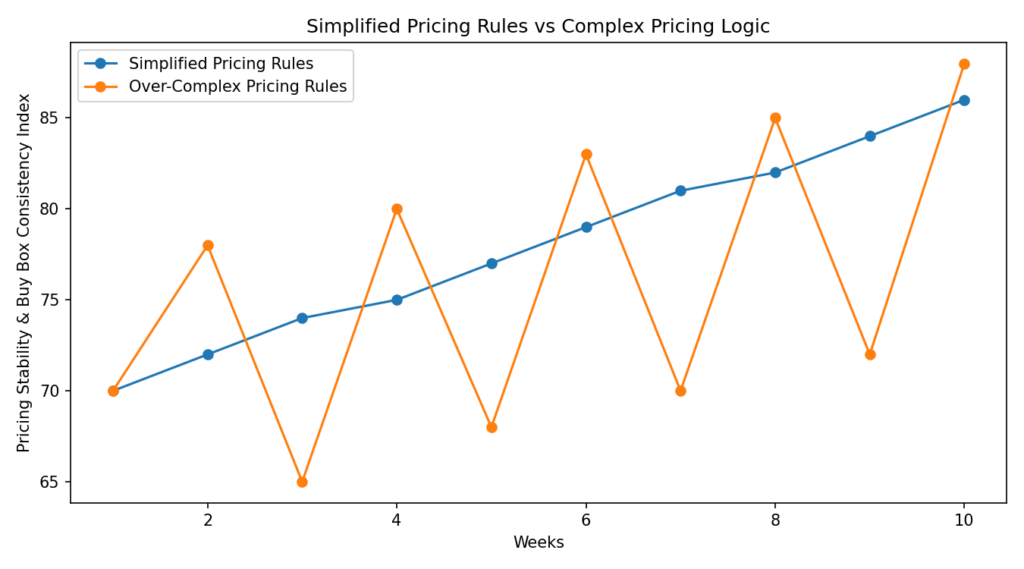
Graph Explanation
This graph compares two sellers across a ten-week period.
X-Axis
Weeks
Y-Axis
Pricing stability and Buy Box consistency index
What the graph shows
- The seller who simplified pricing rules shows steady improvement week after week
- The seller using complex pricing logic experiences repeated spikes and drops
- Over-complex rules create volatility and unpredictable outcomes
- Simplified logic produces smoother growth and stronger Buy Box stability
The visual clearly demonstrates that simplifying pricing rules improves predictability and control.
Why Simplified Rules Scale Better as Your Catalog Grows
As ASIN counts increase, manual oversight becomes impossible. Complex pricing structures do not scale well because troubleshooting becomes slow and risky.
When you simplify pricing rules, it becomes easier to apply logic across multiple SKUs, duplicate successful strategies, and maintain consistent behavior without constant intervention.
Simplicity enables scalability.
How InstaRepricer Helps Simplify Pricing Rules
InstaRepricer helps sellers simplify pricing rules by providing clear visibility into active logic and eliminating unnecessary overlaps.
Instead of stacking conditions endlessly, sellers can organize rules by intent, apply boundaries consistently, and adjust pricing behavior without introducing instability.
This allows sellers to maintain control while reducing rule count not increasing it.
Why Fewer Decisions Lead to Better Pricing Outcomes
Pricing systems perform best when they remove unnecessary decision-making. When sellers must constantly evaluate whether a price change is correct, consistency suffers and reaction quality declines.
Reducing decision points allows pricing behavior to remain predictable. Instead of second-guessing outcomes, sellers can focus on understanding results and refining strategy over time.
Clear structure creates confidence, and confidence leads to better long-term performance.
Final Thoughts on Simplifying Pricing Rules
Pricing success does not come from complexity. It comes from clarity.
When sellers simplify pricing rules, they reduce volatility, protect margins, and regain confidence in their pricing system. Fewer rules, when designed correctly, outperform dozens of conflicting conditions.
Simplification is not a step backward. It is the foundation of long-term pricing control.