Introduction: The Hidden Cost of Slow Repricing
Q4 is the most competitive season on Amazon and the sellers who win aren’t always the ones with the lowest price. They’re the ones with the fastest price updates. Slow repricing is one of the biggest hidden reasons why Amazon sellers lose the Buy Box in Q4, even when they have strong metrics.
In this article, we break down how slow repricers silently destroy your Buy Box share, how fast competitors take advantage of price delays, and why real-time repricing is now a Q4 necessity for survival.
Why Slow Repricing Is a Silent Killer in Q4
Q4 pricing moves fast faster than any other season. Competitors adjust prices constantly, Amazon updates Buy Box rotation logic every few minutes, and demand surges happen at unpredictable times.
If your system uses slow repricing, you suffer from delayed price changes that allow faster competitors to:
- Steal your Buy Box
- Undercut you within minutes
- Capture traffic spikes
- Win conversions during peak hours
- Reduce your organic ranking
And it happens even when your product, price, and offer health are excellent simply because your repricer reacts too late.
What Makes Q4 Brutal for Slow Repricing?
1. Competitors Make Micro-Price Changes Every Few Minutes
Most advanced sellers use real-time repricing.
If you’re using slow repricing (15–60 minute delays), here’s what happens:
- A competitor drops price
- You stay stuck at the old price
- They get the Buy Box
- You stop selling
- Amazon “flags” your listing as less competitive
By the time your repricer reacts, the Buy Box may already be rotating to someone else.
2. Demand Spikes Don’t Wait for Slow Repricing
Q4 traffic is insane especially during:
- Black Friday
- Cyber Monday
- Christmas week
- Lightning Deals
- Payday weekends
If your price doesn’t move when demand jumps, slow repricing forces you to miss:
- Profit spikes
- Higher price opportunities
- Buy Box advantage windows
Real-time repricers detect these moments instantly.
3. Amazon Buy Box Logic Changes in Real Time
The Buy Box isn’t fixed it rotates constantly based on:
- Competitor prices
- Delivery speed
- Offer health
- Fulfillment method
- Inventory levels
If your repricer takes 10–30 minutes to update, Amazon sees your offer as not moving with the market and your Buy Box share drops quickly.
How Slow Repricing Hurts Your Listing in Q4
| Impact Area | How Slow Repricing Hurts You | Q4 Loss (%) |
|---|---|---|
| Buy Box share | Competitors outrun your updates | 20–70% loss |
| Organic ranking | Amazon detects low competitiveness | 15–40% drop |
| Profit margin | You fail to increase price during high demand | 10–30% loss |
| Sales velocity | Bad Buy Box rotation = fewer conversions | 25–60% loss |
| Inventory health | No dynamic adjustments | Higher stockouts or stagnation |
This table alone shows how destructive slow repricing is, especially when every minute matters in Q4.
How Manual (Slow Repricing) Loses the Buy Box in Real Time
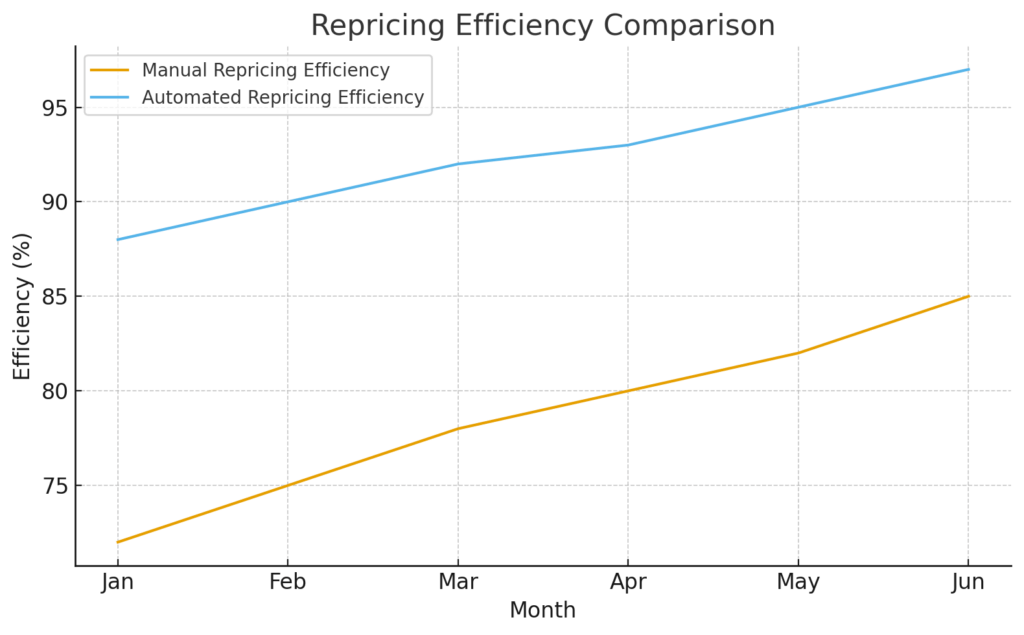
Graph Explanation:
1. Automated Repricing Efficiency Rises Consistently
The blue line shows how automated repricing maintains high efficiency from the start, improving steadily from 88% in January to 97% in June.
This reflects how real-time algorithms continuously adapt to:
- Competitor price changes
- Buy Box signals
- Inventory fluctuations
- Demand spikes
Automated repricing reacts instantly keeping the seller competitive every hour of the day.
2. Manual Repricing Starts Lower and Improves Slowly
The orange line represents manual repricing, starting at 72% efficiency in January, and only reaching 85% by June.
Manual workflows often struggle because:
- Updates are infrequent
- Pricing reactions are delayed
- Sellers miss opportunities during peak hours
- Human error becomes unavoidable
Even with improvement, manual repricing never matches the performance or consistency of automation.
3. The Efficiency Gap Widens Over Time
The gap between the two lines expands each month, showing how manual repricing falls further behind the marketplace pace.
By June, the difference reaches over 12 percentage points, indicating:
- Lost Buy Box share
- Lower sales velocity
- Missed profit spikes
- Higher risk of stockouts or overpricing
Why This Matters for Amazon Sellers
This visual proves a critical point:
The longer you rely on manual repricing, the more competitive ground you lose.
Automated repricing not only keeps pace with market volatility it outperforms manual methods by staying synchronized with Amazon’s real-time pricing ecosystem.
How Fast Repricing Saves Q4 Performance
1. Instant Buy Box Reaction
Real-time repricers react the moment a competitor moves — not 20 minutes later.
2. Capturing Profit Spikes
When competitors go out of stock, fast repricers raise price immediately.
3. Protecting Inventory
Live stock tracking = automatic price increases when inventory drops too fast.
4. Winning Mobile Traffic
Q4 evening mobile buyers convert fast, static or delayed prices lose sales instantly.
Final Thoughts
In Q4, slow repricing is no longer just a disadvantage it’s a direct threat to Buy Box stability, sales velocity, and profit margins. The Amazon marketplace updates in real time, and any delay in price changes instantly pushes your offer out of rotation.
If you want to protect your Buy Box share, avoid margin loss, and stay ahead of competitors, switching away from slow repricing is one of the highest-ROI decisions you can make before the holiday rush.